Yearly Archives: 1946

CHANGING OF THE GUARD


The duties of an adjutant at Christmas are always onerous, but last year, in Alexandria, they were peculiarly so for one adjutant on account of Sappers Griffiths and Carlew. The adjutant’s primary duty on Christmas Day is to steer his colonel safely through the alarming succession of social occasions which custom and Christmas spirit make necessary. He has to keep an eye on the “old man” and exert tactful influence at little parties which start early in the morning, with company commanders, other commanders, with the R.S.M. in his luxurious little room, at the sergeants’ mess, and, of course, in his own mess.

At the same time the adjutant has to make sure that the complicated arrangements, for the Christmas dinner of the men are carried through, get the colonel to the football field to kick off in the inter-company final at 1000 hours, watch over the officers’ mess, and be available for any crisis which is very likely to arise over a family of about seven hundred celebrating soldiers. On top of all this there was, last year, the problem of Griffiths and Carlew.

These two soldiers were residing in the cells under close arrest awaiting trial by court martial.  They had been naughty in quite a big way, and their A.F. 122 showed that they had often been very naughty before.  So that when they asked the orderly officer a few days before Christmas if they could be allowed to leave their cells and join their seven hundred comrades at dinner on Christmas Day the answer given by the adjutant was a definite negative. He had enough to worry about, and their custody was his responsibility.    Sentiment is all very well over Christmas; goodwill towards men is more or less laid down- but not with such as Griffiths and Carlew.

On Christmas morning the adjutant left the colonel in the doubtfully safe company of his second in command, with the points of his speech to the men written on the back of a cigarette packet in his pocket, and went down to the guard-room. It had been arranged that six lance sergeants should relieve the guard between 1200 and 1400 hours so that the guard could dine with the rest of the men, the sergeants dining later at 1600 hours. The handing over was successfully carried out, the sergeants making bright remarks and the guard brighter ones.

“Any prisoners, sir?” asked the self-appointed guard commander. Griffiths and Carlew were opened up and displayed. The adjutant looked at them and went weak. Would they give him their solemn words that if they were allowed up for the dinner they would not get drunk and would return to the cells directly it was over? They would, honest, sir, they would. Would they realise that if there was any monkey business it would be a court martial for the adjutant? They did realise it. So they were liberated.

The long concert-hall was a bedlam of light-hearted soldiers, pledging each other in the abundant beer cheering, perspiring officers who were trying not to stain their jackets with gravy as they bore loaded plates, and booing the R.S.M. in the most hilarious manner as he poured out beer. In a corner Griffiths and Carlew sat together, amid a covey of friends, eating and drinking, probably the happiest pair in that happy little army. They exchanged a confident wink with the adjutant, who brought them a very large jug of beer.

Everyone cheered the colonel so much when he was hoisted on to a box to make his speech that all he could do was to shout “Happy Christmas” and raise a tankard to them all.

The meal, gargantuan as regards food and bedlamic as regards noise, came to its end, and the men went away to get their heads down for a few hours before setting forth in the evening into Alexandria for cinemas and clubs: all but a persevering few, about fifty, who gathered in little knots round beer barrels and sang lustily. Eventually they were ushered out, and only the Egyptian cleaners, well fed and very happy, remained. Then the adjutant thought of Griffiths and Carlew and with the R.S.M. hurried down to the guardroom.

They were both there. Griffiths sat at the table where the guard commander sits and Carlew stood at ease by the main gate, a steel helmet on his head, a rifle with bayonet fixed in his hand. He sprang to attention as the adjutant and the R.S.M. stood, slightly bemused, regarding him. Griffiths, the temporary guard commander, explained. When they returned as promised only one sergeant was on duty, and he had handed over his rifle and gone away, saying something about a darts match in the mess. The guard had not turned up and they had carried on. We were not to worry; they would carry out the guard.

The R.S.M. pulled the corporal off his bed in his barrack-room and asked after the rest of the guard. The corporal was embarrassed; he had just sat down for a minute and . . . He would muster his guard. Ten minutes later the guard hurried in, a little sheepish, but relieved to see that the R.S.M. was not his everyday self; he twinkled. They assumed their duties. Griffiths and Carlew looked slightly pathetic, standing in the guardroom

I’m afraid you’ll have to go back,” said the adjutant. “Very good, sir.” said Griffiths. He took the key from its nail and unlocked the cell door. “Get in, Jock,” he said, handed the key to the adjutant, and went in himself. “It was a fine dinner.” he said. The adjutant locked the door. At 1900 hours a Sudanese waiter came down from the officers’ mess with a tray loaded with two complete Christmas dinners, a new pack of cards, and twenty cigarettes. There were also four bottles of beer. So Griffiths and Carlew had two Christmas dinners. What is more, there was a brace of very good cigars under the napkins which the mess waiter had provided.

David Scott Daniell

The Manchester Guardian; Dec 18 1946
 

SOLDIERS OF KING GEORGE

About lunch-time one day in July, 1944, a jeep came into our camp, drove cheekily between the tent-pegs right up to my tent, and the driver, an American officer whom I knew quite well, said: Say, lootenant, would the major and you come to supper with us to-night at head­quarters?” “Sure,” I said, “and thank you.” ” Good,” he said; “seven o’clock. We’ve got some music after­wards. Does the major like good music?” “Yes, very much.” He drove off, weaving his way between the tents while startled sappers watched him.

Our company was operating on the west coast of Italy, which was the American Fifth Army side of the campaign. So we had much to do with the Americans and we all got on nicely together. There was not much social life, as we were well forward, but sappers and G.I.s mixed affably enough, though each was envious of the other’s rations.

It was not until an hour later that we realised why we had been invited: it was July the Fourth and therefore Independence Day. We were reminded of this when the ration sergeant asked us to go to the ration store. There we saw a neat row of twenty-eight large turkeys: real turkeys, not tinned. The sergeant had laid them out reverently in a precise row, their necks straight out. The sergeant cook was there, and we were all awed. The field butchery and the bakery had not come up with us,  and for three weeks we had lived on tinned food, biscuits, and dehydrated potatoes. It seemed that an American truck had driven up, off-loaded the turkeys, left a message about “with the compliments of Uncle Sam for you Limeys,” and went away.

Being, like all Army cooks, a master at improvisation, our sergeant cook said he would manage for the evening meal if he could have a fatigue party of eight. Before the major and I went off to our supper we watched the men lined up for dinner, which was served at half-past six, with a light “tiffin” at noon. The men were, of course, delighted. The ration sergeant had managed to get hold of real potatoes, and beans made the second vegetable. Tinned fruit followed. The comments of the sappers, tired of bully beef and “M. and V..” rippled up and down the line. “Lend-Lease does it again!” “They aren’t real; they’re dehydrated and puffed up again.” “‘Got a wishbone, sarge?” “Where’s the Christmas pudding, eh?” A spirit of carnival was abroad, and, leaving his three hundred charges happy with their unexpected feast, the major drove me away to our supper party.

The headquarters of the Engineers Combat Battalion was a requisitioned villa on the outskirts of the devastated little town.  Feeling rather shy, we straightened ourselves up before we went in. We had put on Sam Brownes over bush-shirts in honour of the occasion, and leather and brass shone. Then an officer who knew us came out and took us into the dining-room, where three trestle tables were arranged in a “U,” and introduced us round. A corporal came in and said “You can sit down, gents,” so we did. We were put one each side of the colonel, and before he settled he announced, “Gentlemen, we have the privilege this evening of the company of two soldiers of King George.” He then introduced us by name, and everyone clapped. To cover my embarrassment I remarked to my neighbour on my right, “King George the Sixth, not the Third.” The observation was kindly appreciated and passed around.

It was a wonderful supper, or so it seemed to us. There was an enormous amount of turkey; legs and wings together in dishes and slices of breast in others. There were fruit drinks, and after the first course a cake which seemed to be traditional, and fruit and canned cream.   But it was not the splendour of the fare which affected us so much as the kindness and cordiality of our hosts.

As well as the warmth of the friendliness shown to us, a special kindness matching the occasion, there was a feeling of national pride, and although there were neither toasts nor speeches we were aware that the events of 1776 were alive in their minds. This made their genuine cor­diality to us two “soldiers of King George” strangely affecting.

Afterwards we all went to the little theatre of the town, which was damaged by blast and had a battered appearance among the ruins around it. To our amazement we learnt that the “music” was to be a recital by one of the world’s greatest violinists. By typically bold organisation they had sent a staff car 200 miles to Rome and had brought the master north to our little wreck of a town.. To have thought of doing it was courageous enough; to have succeeded was masterly.

The stage was lighted by two temporary lights and was hung with Army blankets. The great man came on to the stage, wearing British battle-dress, carrying his violin. There was a great deal of applause. He bowed and then said, in broken English, “Before I begin my concert I will play the National Anthem.”

Everyone stood up and we were especially stiff to attention out of courtesy to our hosts and the impor­tance of Independence Day. The artist raised his violin and then played “God Save the King.” The audience gave no rustle or movement, and stood in a most soldierly manner until the end. Then after a tiny pause everyone sat down. Our own thoughts were confused. “And now.” he said, “I will start with three little pieces, first Debussy’s ‘La fille aux cheveux de lin’ . . .” and the concert began.

 The Manchester Guardian; Oct 30 1946


SHOES FOR ANTONIO

I want to give my very good friend Antonio Lanave, who lives in Bari, in Italy, a pair of shoes – a simple proposition, but it has not proved to be so.

The project began two years ago. I became a friend of his, and when I had an hour to spare in the mornings I would park my fifteen-hundred-weight truck outside his house and knock at his door, a gaggle of Italian children standing around hopefully. The door would be opened by a patent wire-and-weight idea of Antonio’s, operated by one of his two devoted elderly sisters from the first-floor landing, and I would see Antonio standing at the end of the corridor, ready to bow when he saw who it was.

Then a pleasant hour would pass, sitting in his crowded yet neat little studio, crowded with things, not people. He would continue to work while I sat and watched and we talked as best we could, he having no English at all and I but a British soldier’s Italian. But we became great friends and we sat together and drank the delicious little aperitif his sister brought and the two or three little cakes or almonds. He is sixty-three, short and stout, with nothing unusual about him except his penetrating and questioning eyes. He is a veritable “maestro” and a painter of renown; his work is always highly competent and sometimes inspired. He wears a plain blue suit, a scarf loosely over his shoulders, and a plain cloth cap.

It was at one of such contented little visits that the question of shoes came up. I had a new pair of shoes, bought from the Officers’ Shop. They were plain, honest, brown English shoes, and he admired them with awe and respect. One felt slightly self-conscious about the Empire. His shoes, he pointed out, were not fine, strong, healthy leather, but imitation, mostly cardboard. They had cost a thousand lire. They were unobtainable then, and it was not possible to get them repaired. To such a pass had the Government brought things. Good shoes he loved; he worked on his feet and he suffered, with his feet.

When I left Bari to go to Egypt our leave-taking was sad. Promises to come back, the future peace, the return eventually to England for me; all these glad things were brought up to lessen the pang of parting. Then he produced his present, a genuinely inspired picture of my wife and baby, made from a photograph, the colouring learned by artful questioning at various times. It was a handsome present indeed. What could I give him? Perhaps some shoes? His face lit up. Yes, that would be handsome: some shoes and some dress material for his sisters? So the debt of honour was incurred and we parted.

In Egypt the unit had an ingratiating little Egyptian cobbler who willingly made shoes for the British officers. The size of Antonio’s feet was given to him and he set to work and from the finest leather made a strong, handsome pair of shoes. The carpenters made a box for them and they were joyfully posted, not direct to Antonio, because one lacks confidence in civilian posts abroad, or did when the shoes were sent off some six months ago. They were posted instead to a brother officer with a request that he deliver the shoes.

Two months later I left Egypt for home. A week after I had left the parcel of shoes turned up again at our camp in the desert. The brother officer had also left Italy for home, and the Army Post Office, a very efficient and tidy-minded branch of the Service, returned them to the sender. The orderly-room sergeant thereupon repacked them and sent them to England after me. At the same time a letter came from Antonio thanking me in courteous and fluent terms for the dress material, and for the shoes, which had not yet arrived. The dress material had been posted two weeks before the shoes, which had been announced in a letter.

Recently the shoes arrived safely here in England. A new parcel was made up. This time it was addressed to Antonio himself at his address, knowledgeably written backwards in the approved and very logical Continental style. We felt better when they had at last gone off, after their journey from Egypt to Italy, Italy to Egypt, and Egypt to England.

Three days ago the postman brought the parcel back, with a little label saying that “new shoes” are prohibited for export except under licence from the Board of Trade. After all this one could not give in, and Antonio has a great faith in the integrity of the British. It was therefore important for international relations, as well as for Antonio’s feet, to persevere. Application was made to the Board of Trade and a handsome form came back, which took some filling in, because the circumstances are not the normal ones. The price f.o.b. and the question of whether or not it was a “firm order” made the modest gift seem like a gross of seven-league boots. However, it is hoped that the Government will deign to license the export of this one pair of shoes.

There must be a moral in all this. It is a pertinent sign of the times that Antonio, a professional artist of position, should need a pair of shoes and that all this trouble should be so very much worth while; maybe it is an indication that nations should not let their Governments “stab” other countries “in the back-” Yet Antonio, who has spent his life quietly painting pictures and minding his own business, could not by the wildest stretch of imagination be considered a “war criminal.” He still has a gigantic canvas and frame, ten feet by seven, in the entrance hall of his house, from the days -when he was commissioned- and commanded- to paint a haughty picture of Il Duce. He never painted it; he just stalled until there was no need. The shoes have many difficulties to surmount yet, especially when they reach Italy. I feel that there will be more forms to be filled up, and very complicated ones, by Antonio. But if all goes well, one day Antonio will take his little eager steps to and from his canvas with his small feet well shod. The pains will have been worth while.

DAVID SCOTT DANIELL.

The Manchester Guardian; Jun 27 1946

22 MARCH 1946 (or later…)

ROSEMARY COTTAGE, GREAT ALNE, ALCESTER, WARWICKSHIRE.

My Dear,
Seeing as how this might reach you before you leave, and seeing as how I rarely have the chance – thank God – of writing letters to you, I thought I’d blue a stamp (joke) on a note.

Its mildly rainy, a warm growing day. Its noon o’clock on Saturday morning, and people have that unmistakable Saturday look to them, even horses- and Jack Shirt, not looking Saturday but very Tuesday, has gone by standing up in a float behind a Saturday looking horse.

After you telephoned yesterday evening – which was a Good Thing to Have done – I got rid of Cavey, after watching, with her, Dickie and Klaus having an invasion on the dining room table, Klaus being very arrogant, and ill treating prisoners, and having fifth columnists, and claiming gigantic victories, and Dickie, the most tolerant good natured child in the world, laughing and agreeing, and losing ships and then winning in the end, which is as it should be, inspite of heated explanations by Klaus that he couldn’t have done, though Dickie plays with absurd integrity.   Then I made them have a bath, and Dickie revelled in it and came out fluffy and pink and old Klaus agreed to immersion.   Then they sat, pyjama-ed in front of the fire and ate shredded wheat and a cake each and went to bed, where there were modified High Jinks. I went to the Guard room for an Hour, having a relief there, and cleared up that other business tactfully by leaving the shovel outside and telling everyone to go out for ten minutes when they went on duty, and the one concerned to clear it up.   No questions, everyone to do it.   So it was solved, heigh-ho.    Cornwall asked blandly where he could find it!!   Subtle, but not subtle enough!!!

Then from 10.30 to 3 I worked on reading through all the past typing and evolving the new chapter details, and then, pleasantly tired, to feed, finding Dickie, left neatly on your extreme edge, lying like this : –

I sorted him, he not waking, and slept soundly until the alarm went off at 7.30.   He said “Hullo!” in mild and not unpleased surprise, and I got up while he and Klaus and Candy frolicked on and in our bed.   Then they broke their fast at 8 of the clock and left, because of Dickie’s birdlike cycle, at 8.30 for 9 school.

Mrs. A. came and coped happily and kindly and went at 10.30, I had a fire here and the grate done next door. Then I wrote to Anne, Derry and McCulloch, because Anne wants me on the 31st. – you might be able to come – and then Derek came.   We had raspberry milk shake and cake and he dusted my books while I went to post and to Mrs. Beare. There we talked dance and quarrelled harshly because Nicky wants to bring a cabaret and Mrs. Beare said that when I was older I would know that people don’t like people singing at dances, they want to dance.   I said that when I was old I’d probably be out of date with dances. She said I always was awkward and difficult, not that she meant to offend me.   I said I was not above being offended when people were quite so blatant.   She fetched beer and cigarettes and told me how wonderful I was with the Home Guard. I said I was pretty hot at dances, too, and we talked until eleven thirty, she very charming and with her claws held deeply in.   Bloody hell, I thought, you’ll read about a Mrs. T.F. one day and perhaps you’re kidneys will be better after that.   So that was all very nice and cosy.

I came back, telephoned Eleanore, sent Derek down with more novel and to retrieve the other, and here I be. Kidney stews thickened and is on the hob here, scenting the room.   Potatoes done and on the hot plate waiting for the magic of the switch.     Boys due.   Football match on our ground at 2.30, me, ref., alas.    Then novel until I peter down to the Jeavons for an hour this evening. I’ll cadge lunch there tomorrow and take my bit of rabbit.

Candy well cats hollering a bit, but well. And all bloomin.  You are needed though.   We’ll not half appreciate you on Tuesday.

Fare thee very well.   Klaus is out all day tomorrow, and Dickie goes home for dinner.
Nice fire here, cosy room, all clean, you leave a GAP.
Bless you, and love to:-
your mother, (bless her)
Honor, her folks,
Aunt Ame and her colonel’s trousers, (Does she wear them, is that it?)
Auntie Min, her good husband, and their daughter your cousin,
and all the others, especially the one with the tea-set, whom I have yet  to meet,
but for whom I have already a grateful regard.
Candy sends her love.
So would Klaus,
Ever. . .
David

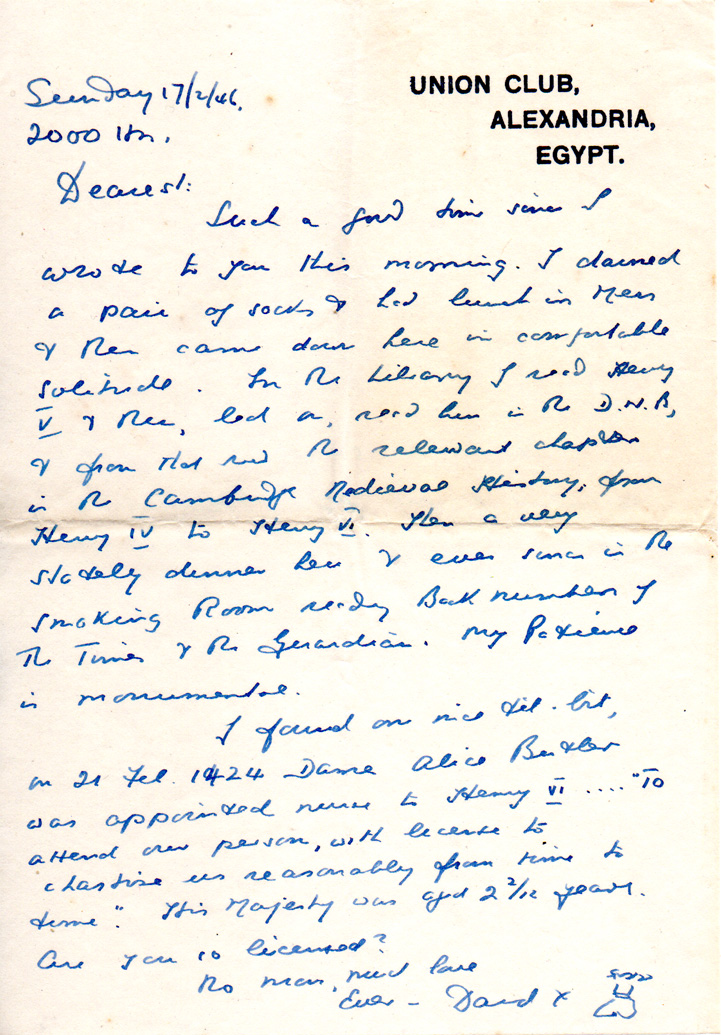
17 February 1946

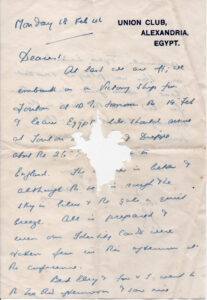
19460217a                             Still at Alexandria ! We must both assume a great patience, for its no use railing at the elements ! We’ve a famous storm here & in this part of the Mediterranean ! I was to go on the Ville D’Oran, draft 464A, & all laid on to embark yesterday & sail today. But the ship can’t get into port & is going to Port Said. So now it’s the Colorado Springs Victory, a converted Liberty, on the “19th, or after”. If the storm doesn’t abate will just have to wait ! It may be a week yet before we leave. So stand down all arrangements, read & sew, & yet again, Patience. I’m using the Union Club hard & read the days away, all packed & awaiting news. By my associations here I get the information before the staff at Sidi Bishr, and directly we embark I’ll send a cable. You can then estimate arrival times, the quickest being D + 9. But if there’s a delay at Toulon or a slow passage because of the heavy seas, or a delay at Dieppe because of a naughty channel, then it can be D + 14. It’s a pity & could be annoying if annoyance at things so elemental were not illogical. I am securely in the machinery of Demobilisation camps and it is now the circumstance, uncontrolled by the army, that matter. So we must be patient, pray for the wind to stand fair and remember that our reunion will come !

                        Yesterday morning I passed by taking coffee in Town & then joined Ian who had come up at the Mess & we played Poker Dice. After lunch to Henry V again & loved it more than the day before. In the evening a cocktail party at the Carlsons & a quiet supper with Ronnie Fox – who with Bel Eley comprises our draft – at the Santa Lucia & bed. It is midday now & we’ve been up to Sidi Bishr, where we should normally be living in wet blowing tents, to see what was happening. A large mess full of Very Patient Officers !

                        It’s a very lively storm. Great green seas hurling themselves over the Corniche, a tearing quasi-hysterical wind everywhere. It will bate & be blue white & gold as usual.

                          I am being Patient !

                        The John Trevor card arrived yesterday ! It is nice & blowsy. As ordered I’m keeping it.

                        No news, I’m sort of Waiting Roomish. I’m so sorry this frustration should have come to you at the end like this.

                        The last camp for me is Hereford, so my last crossing will be Hereford – Great Alne via Birmingham & Alcester I suppose.

                        I’ll send again when I have any news.
19460217b

8 February 1946

19460208e
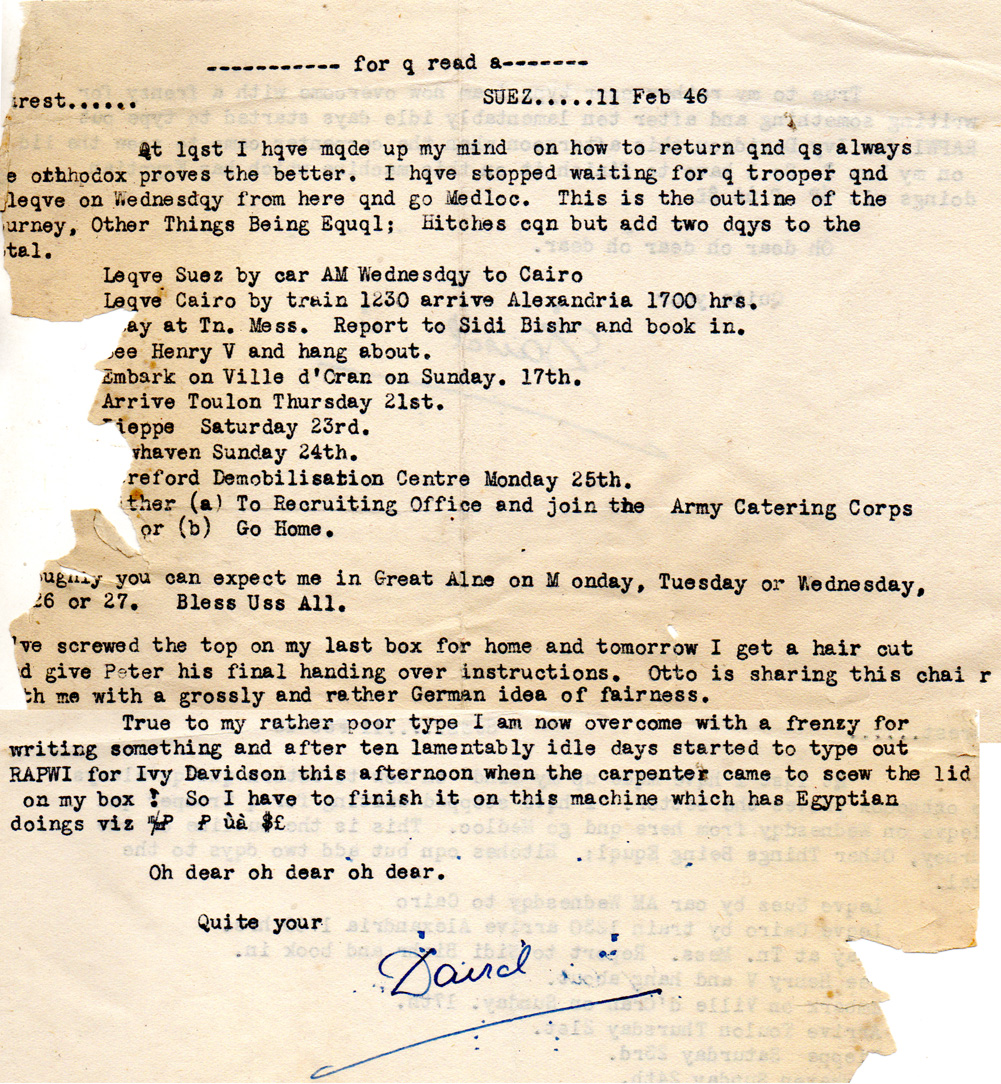
Slowly the days pass, yet pass they do. This consolation in the thought that by the time you get this I’ll be on my way even if I eventually turn orthodox & go “Medloc”. The situation is now either a ship on Monday the 11th or if she’s full, then to Alex on Wednesday & the normal route on Friday – Alex – Toulon, train to Dieppe & viola ! This evening is the Dance, tomorrow a much publicised football match, the Alex Group team V the Suez one. On Sunday I intend fishing in the Red Sea, the Gulf rather, & Monday just another day.

                        I’ve packed my last M.F.O., Because I’m not very good at such things it’s been made much too big, it’s enormous ! Good wood for bookcases though. It has got my bedding, the second typewriter, & remaining non-essentials. I’m having it strutted off. I put in 6 tins of Tomato juice in case it’s not easily obtainable at home, for R.J.S.D.

                        You know, it’s easy for me. I’ve been junketting about all over the place & rarely has it been dull. But you have just carried on. When I arrive back it’ll be a new beginning, a new term, all fresh & newly painted. There must be a new beginning for you to. You need a break, & then re-start, fresh & with new exercise books. The ideal would be to move our house & home to a new site, but that’s not very practicable. There must be an answer to it. In all of this business yours has been the more difficult part. Another thing is that by the nature our trade we must not be too long getting resettled. A few weeks frittering about is the most we can do. The happiest memories I have, out of a whole Saga of memories, are the “workaday” ones. Of course, I’m desperately lazy about writing, because my lack of facility makes me balk at it. However, with your two very charming mouths there as evidence of what I have to feed it should be easier.

                        D’you know I shall actually see Richard soon ! If you & he preferred to come to Birmingham to collect me, do so, as you wish. But I’d be quite happy to bus out & find your home. Mama Ann could come to the station if you wished, and I think I’d be a bit eagerly to get the first ‘bus out of Alcester, or the local train. It is rather tantalisingly slow though, isn’t it ! Remember you, Candy, Chris & I on it, no that was from Henley.

                        If you can borrow car for a week we’ll motor to Kettering. We can get petrol. But train’s no trouble.

                        I can write, & think of nothing else but going home, to you. I did, or tried to do, a Thing yesterday & sent it to you for Guardy if it’s reasonable after its journey.

                        I read in the paper that food is short. We must get Marjorie to let us have a fairly good dollop of milk. I’m not a food fad as you well know but I’m sure that it’s common sense that plenty of good milk is the answer to diet & health. And we’ll do away with the old garden. I’ll dig. I’m against over eating (in theory anyhow)

                        Otto is a sun worshipper & as the sun chases around this office he shuffles around too. He’s precariously balanced on the edge of the desk & as the sun moves he’ll surely fall off. He’s always complaining to me about the sun.

                        I’ve packed the Dickie picture from the tent pole & now I have no picture. I got Peters May’s cloth & hope it’s all right. I got two 19460208g pieces of silk, you to choose the one you like. Sandals I’ll bring.

                        It is nice, writing to you.

                        All my love, still by post, soon by personal presentation.
19460208f

6 February 1946

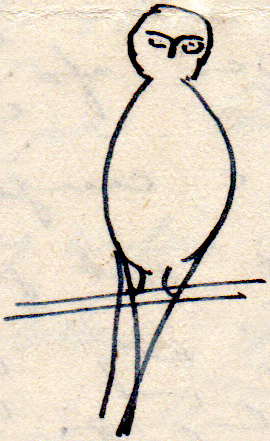
 19460206dThey have in the Mess, living in apparant content & great dignity, one ‘Arry, an ‘Awk. He is alleged to be a sparrow-hawk. I say he’s young because he looks young. He will perch on your fingers and loves lying on his back to have his tummy rubbed. He’s the size of a small cat, but the other way up. No not quite like that* he is very charming & has a super steel tray full of sand & a bar & a long light chain to his left leg. He flew into the launch on Sunday when they were fishing & here he is. All high flying birds wear kind of flying helmets.

Odd how I can’t draw. He’s got lovely feathers & the wings go behind him & cross over. He’s not at all timid, either because he’s too proud to show fear or because he’s just intelligent & knows when he’s well off.

Your 31 Jan letter arrived this morning. You’d had three from me, one of Christmas & two on my Levant travels. The Zionists made my Jerusalem trip even more interesting & at Haifa there was a scare the night I was there, 2 cwt of gelignite was found round the radar station & a curfew was fixed. I’ll not go to Bombay.

How very charming of the G.A.C.C. to defer the supper. Thing is, will they play cricket ? I’m all for it but we must have sufficient reasonably talented playing members. We can do it if people will rightly respond. Has the Maudsley the ground still ? I’m dead against any collaboration with them. Village Cricket must be free of the metallic feudalism of Industry.

Really we are a pair. My little wog cobbler got mixed & hasn’t made your or Mama Ann’s sandals. So today I went to a little shop in Port Tufiq & sought some. Alas, I said. I’ve left my wife’s feet with the Alex Cobbler ! And today’s letter quotes your feet as 8½ – 9 & Mama Ann’s as an inch longer. The Mama Ann ones are OK, yours an inch too long. Tomorrow I’ll arrange the exchange & get you two pairs. There are only ordinary WOG ones & not wonderful but as they are I lay them at your feet. Feet an each smaller than I guessed ! So there.

Nice about the S.M.Y.C. ! How lonely dependent Ronnie will have loved fetching you, taking you back & staying there. I’ll see to Ronnie. I’m glad he’s been devegetatarianated. Runner Beans are a poor basis for life, let alone Marriage ! Colin will be a cavalier of life & a very good Naval Officer. He’s essentially an uncomplicated person, as a child he was wondrously clear of any indirection or doubt & he’s fundamentally calm & ingenuous. Arnold is doomed to dreadfulness, Flossie loves small things too well & Oliver could be distinguished. Greta, whom I knew only as a leggedy beastie of 6 or 10 showed signs of having inherited her mother’s damning goodness. The S.Y.M.C. Were always a rummy crowd. Friendly though.

So the desk has been assembled & the curtains hung ! Do I have a dozing chair?

After long travels the letter referred to by Bertha arrived last week & was duly answered, a good person, Bertha.

Good parrot to break loose at the Dance. How great was the abandon with which it flew around ? We are in the throes of arranging our own dance on Friday. Free drinks & a gargantuan spread. Glad when it’s over. I do hope I get home in time for Farmers Dance. I’d love to go watch you. At long last a dance I enjoy.

Reading Cronin’s new book Green Years. Quite good. Not very. I hope there are some reasonable books on the ship, to while away the hours. I’ll probably go & help stoke.

It’s disgusting how I am doing nothing in the writing line ! But I’m far too excited. Maybe I’ll start of a sudden. My final M.F.O. Box has arrived & I’ll pack it & get it off. I’ve got a bottle of Scotch & two sherries & my bedding, books, typewriter, shoes & odds & ends. I’ll take with me the essentials only & arrive with hardly anything.
19460206e

*19460206f